Saturday, June 2, 2012

This Procession

Yaksha: Kimashcharyam? (What is the strangest thing?)
Yudhishthira: Every moment people are dying all around, yet man thinks he is immortal.

We called her Mini. Mini is a generic name in Bengali for all she-cats, just as Hulo holds for all Toms. We did not feel the need to give her any specific name. One just needed to call her: “Mini Mini . . . tch tch tch . . .aay aay aay”, and within a few seconds our milky-white cat would come running, from wherever she had been – her salt-n-pepper tail held high in anticipation.

She was very pretty, in a motherly fashion. A soft, full, round body, but not plump. With a sweet meow. The face was round, the eyes bluish grey.

She was a real lokkhi cat if there ever was one, but then you might not know what lokkhi means. Lokkhi means goodness, contentment and right conduct -- all these things personified, just what you would expect from the goddess Lakshmi. Lokkhi chhele (good boy), lokkhi meye (good girl), like that . . .  Unlike the other cats we had at various times, Mini never displayed that catlike urge to stealthily grab a piece of fish or mutton from our plates and run away. She would take her usual place by the right side of Father and wait patiently –– until Father would reward her with a morsel or two. The picture is still vivid in my mind’s eyes the way Mini would take up a very tidy posture at the time of eating. There was nothing cumbersome or disorderly in her manner. The tail nicely tucked to one side of her body, the arms and legs drawn closer, the pink tongue vigorously active. We were lucky to have her among us.

Have you ever seen a cat sitting guard over fish that has just been brought from the market? Mini would do just that. Mother would just had to admonish her: “Mini, I am going for a few moments, don’t touch the fish in the bowl”, and Mini will silently consent.

Mini had nothing of the arrogance and aloofness that is so typical of cats, even of the pet ones. One would not often find her walking over the wooden rafters of the roof and looking down at us disdainfully. Even when she took that walk over the rafters, she did it with the express purpose of chasing a mouse, or shifting her cubs to a safer place.

Shifting her cubs was one thing she had to do often. But before I tell you more about that, I must add that I was between five to eight years old at the period when Mini graced our lives by her company. Now, coming back to the point, Mini’s laying cubs was a big occasion in the house. Either Mother would discover this and tell us, or it was the other way round. For a kid like me, it was every time a novelty when after waking up in the morning the first thing that entered my ears was the soft meow of the kittens. It was a matter of minutes to find where the mother kept the kittens. My greatest urge was to touch and pick up one or two of the cubs, primarily to investigate if like all the other kittens, this lot too had their eyes shut (they take a few days to open up, you know). Mini was so good that she would even allow us handling her cubs to a certain extent, and that was quite a big concession considering the aggressive protectiveness that is intrinsic of all cat-moms nursing their newborn cubs. But mind I said ‘to a certain extent’. Even our Mini had a limit of tolerance, and when we crossed that, she would shift the cubs to another secret place.

The main reason for shifting cubs frequently, of course, lay elsewhere. There were many tomcats in the vicinity and that was a real danger. Now you know, nature has ordained the male cats to seek to kill the newborn cubs – a cruel but universal phenomenon. Thus the initial days of the cubs’ lives are very demanding on the mother – she has to protect, feed, train and discipline them, and at the same time also manage to sneak away for a few minutes to feed herself.

There was this guava tree I must mention here, otherwise my story will not be complete. It grew just by our puja room and I had spent, along with my friends, a considerable part of my childhood atop this tree. It was also a favourite spot for Mini to sharpen her claws. From top to bottom of the trunk, the bark was covered with scratch marks made by her.

Inconspicuous to us, Mini was getting old. She lost some weight and her gait was not so easy. She would prefer to lie most of time in the sun and ate less. Mother told us that twelve was a good age for a cat to live, and perhaps it was time she would die. When a cat dies, she usually tries to move afar from the house where she has spent her years. This is quite a mystery. But before this was to take place, something else happened which still sits like a stone on my chest and perhaps is the reason for writing this story here.

It was an autumn evening. The days had become considerably shorter and our playtime in the evening too had shortened. I had just returned home at dusk and after washing had heard a rustling sound in the darkness coming from the guava tree. Were a flock of parrots destroying the fruits – something that should be prevented? I walked to the tree; nothing could be seen in the darkness. I gently shook the tree and it swayed. More rustling sound from up there, as if something was struggling to keep its hold. I shook more vigorously. A white something fell from the height of about ten feet on to the disused wooden table that was lying just beneath the tree. Oh God, it was Mini! I fervently hoped nothing would happen to her. After all a fall of just ten feet is nothing to a cat, isn’t it? Mother and sister rushed our hearing my scream. Everybody was anxious, on the verge of crying. Mini was not able to move much. Mother brought some water and fed her with a spoon. Mini was leaving us. She was going to heaven where her place was sure to be.

In a couple of minutes Mini died. Her death came holding these very hands of mine, someone who loved her so much. To this day I cannot fully make peace with that. This blog, perhaps, is an attempt towards atonement?

It was my first acquaintance with death in all its starkness. Someone, with us just a few moments back, and now, gone, forever. The eternal procession – neither with a beginning nor with an end – had displayed at that very moment a glimpse of itself to me, but I was perhaps too young to fathom that. Later, as I grew older and encountered more deaths, the more the turmoil I felt on each occasion. Now, at 53, it strikes with great force every day that some time, unobtrusively, I too have become a fellow traveller in this procession!

Saturday, August 20, 2011

On Anna Hazare’s Movement

This is a real torture when one cannot take a firm stand on a issue which is holding sway over the country for the last few days. I am still vacillating—sometimes on this side, sometimes on the other. And mostly in between. This happens when the facts are not available though there is no shortage of rhetoric on both sides.


I clearly remember this—when Manmohan Singh first became the Prime Minister of UPA-I, he promised to bring administrative reforms—reforms in administration, judiciary, police, military, everything. This was the much needed second generation of reforms. We believed MMS because after all he was the famed reforms man of the P V Narasimha Rao’s regime.


But sadly this did not happen, even though we are in the middle of his second term. We have not seen a single reform so far, not even much in his pet line of economic reforms. Whatever actions we have seen have been in the domain of the SG-chaired, extra-constitutional NAC crowded with the Harsh Mander types, which prescribed wasteful and corruption-breeding schemes. Why have the priorities changed? The reason is easily understandable. In the PVNR times, the PM was wholly backing MMS, in fact PV was the real reforms man. With UPA-I and II, it is Sonia Gandhi and Rahul Gandhi who call the shots and they are either not bothered about reforms or do not understand the need of it.


India has vastly moved forward since the socialistic days of Indira Gandhi. I still remember those days when to have a bag of cement or a scooter, one would either have to go to the black market or wait for many years. But though we have made some progress, reforms in India is only semi-done. Whatever happened has happened mainly in the economic front. Now India needs, badly needs, the other reforms promised by the PM. Had they taken place, they would have vastly improved the government’s functioning and reduced corruption to a great extent. Over-regulation is our bane which actually gives rise to corruption while pretending to tackle it. The promised reforms were supposed to reduce the regulations (particularly the discretionary powers in the hands of some as Swapan Dasgupta has so nicely explained recently) and create a free and competitive atmosphere.


But what has happened is that the level of corruption has actually increased over the years during the rule of this government. This has happened because politicians and bureaucrats have retained their vast regulatory powers to dispense/deny favours to industrialists. In India the situation is so bad that the industrialists who do not toe the dotted line would simply perish.


This is why I have been against bringing an additional and super regulatory authority like the Lokpal into the picture. We need to unshackle, not to put more shackles. Lokpal Bill appeared to me to be a movement in the exact opposite direction. Also, I cannot exactly comprehend how a few persons can root out both big-ticket and small-ticket corruption (considering the huge number of people involved in the latter). The pro-JLP intellectuals must explain these aspects to people before the latter is expected to form an opinion.


However, anger against corruption is something I do share like everybody in this country. This is why I respect Anna Hazare and his team and this is why watching Annaji’s movement unfolding on the streets and the TV screen brings tears to my eyes. These people have made us feel that there is still some hope left.


The imperious way with which the government has dealt with this issue so far has changed my perceptions to a great extent. Firstly, the treatment they have meted out to Baba Ramdev. In my own circles I know at least a dozen people who follow Baba Ramdev’s yog methods and they have greatly benefitted from it. To call this person as a ‘Dhongi Baba’ is equivalent to insulting all such people who have faith in him. No surprise India Today’s recent polls have shown a sharp decline of the support for Congress party in UP and an associated rise of BJP support there.


Well, Baba Ramdev was perhaps not fit for this fight. He obviously lacked courage that showed in his comic flight. He also prescribes solutions that are too simplistic. In other words, he does not have a proper understanding of the issues.


The Anna Hazare team comprises of much better intellect. To ridicule them will simply not do. Ordinary people have a remarkable wisdom and the huge popular sentiment pouring on the streets cannot be ignored. All this talk about being unconstitutional (which is a lie) and extra-parliamentary is mere technicality. Democracy is India is firmly secured. In fact this is also another face of democracy. When the government does not act, people have a right to bring pressure upon the government.


The anti-Anna intellectuals have so far been mostly sarcastic and nothing much more than that. They should now come out more in the line of explaining the matters. They should explain better alternatives, if there are any. They maintain that the JLP is draconian, but why? For asking life imprisonment for the big-ticket corrupt persons? Well, I would rather like execution for them, China style. In fact I feel that punishment for crimes in our country is too mild. Corruption in the judiciary is perhaps the most alarming thing and I hear that there is an Accountability bill lying with parliament on that—these things are to be explained.


Personally, my greatest problem with team Anna is the presence of socialistic, anti-industry, anti-capitalism outlook (eg Prashat Bhushan, Medha Patkar) which, in my view, will only work towards retarding India’s growth.


The government could have discussed the issues threadbare with the Anna team, inside the parliament, and might have had interactions with the public through the media. But it has not done so. The utterances of people like Kapil Sibal, Manish Tiwari and Divijay Singh only strengthens public suspicion that the government is attempting to hide things and is not interested in tackling corruption.


The way I see the matter right now is that in our country nothing comes the perfect way and perhaps something better will come out of this ‘imperfect’ Jan Lokpal Bill. We always felt hopeless against corruption, terrorism, etc … now we can at least see some hope.


(Ultimately this post remains a confused babble—a mirror of the present working of my mind.)

Tuesday, August 16, 2011

Changed Position—1 (On Sri Lanka)

In an earlier blog, I supported the military action taken by the Sri Lankan government against the LTTE and its leader Prabhakaran. I still hold that eliminating Prabhakaran and his army was the only way to achieve peace in that region. But the information that has come to light later on the military offensive has made me to change my views on some matters.


It is said that no less than 40,000 Tamil civilians have been killed in cold-blood by the Sri Lankan army in the conflict. The Tamil people were told to move to so-called safe places where they were then massacred. This is totally unacceptable; this is war crime of the worst kind. Also the work of rehabilitation of the displaced Tamils is moving at snail’s pace and their condition at the camps is horrible.


Obviously the government of SL have not been able or been willing to bring itself above the narrow mindset of ethnic chauvinism. It is therefore left to the rest of the world to bring justice to the whole issue.


Rajapakse and his team must be tried for war crimes and sentenced.

Thursday, August 4, 2011

Babri Masjid

The day the Babri Masjid was felled, I was in the Konkan region. In the evening I made my customary call to our Cochin office to discuss the latest work-related issues. My Bengali boss took the call and he sounded very upset: “Whatever has happened is really bad; very, very bad.” Since then, I have heard and read this comment many times. In fact, the thinking class is totally unanimous in their opinion that the destruction of the mosque is a blot on the history of India. Somehow I do not agree totally. Or rather I would have liked a third path.


Many a times I have thought of writing down my views on this topic (and then to proceed to write another post on P V Narasimha Rao), but sheer laziness as well as my reluctance to take on a controversial issue of such magnitude has always stopped me. Finally, today, the time has perhaps arrived . . .


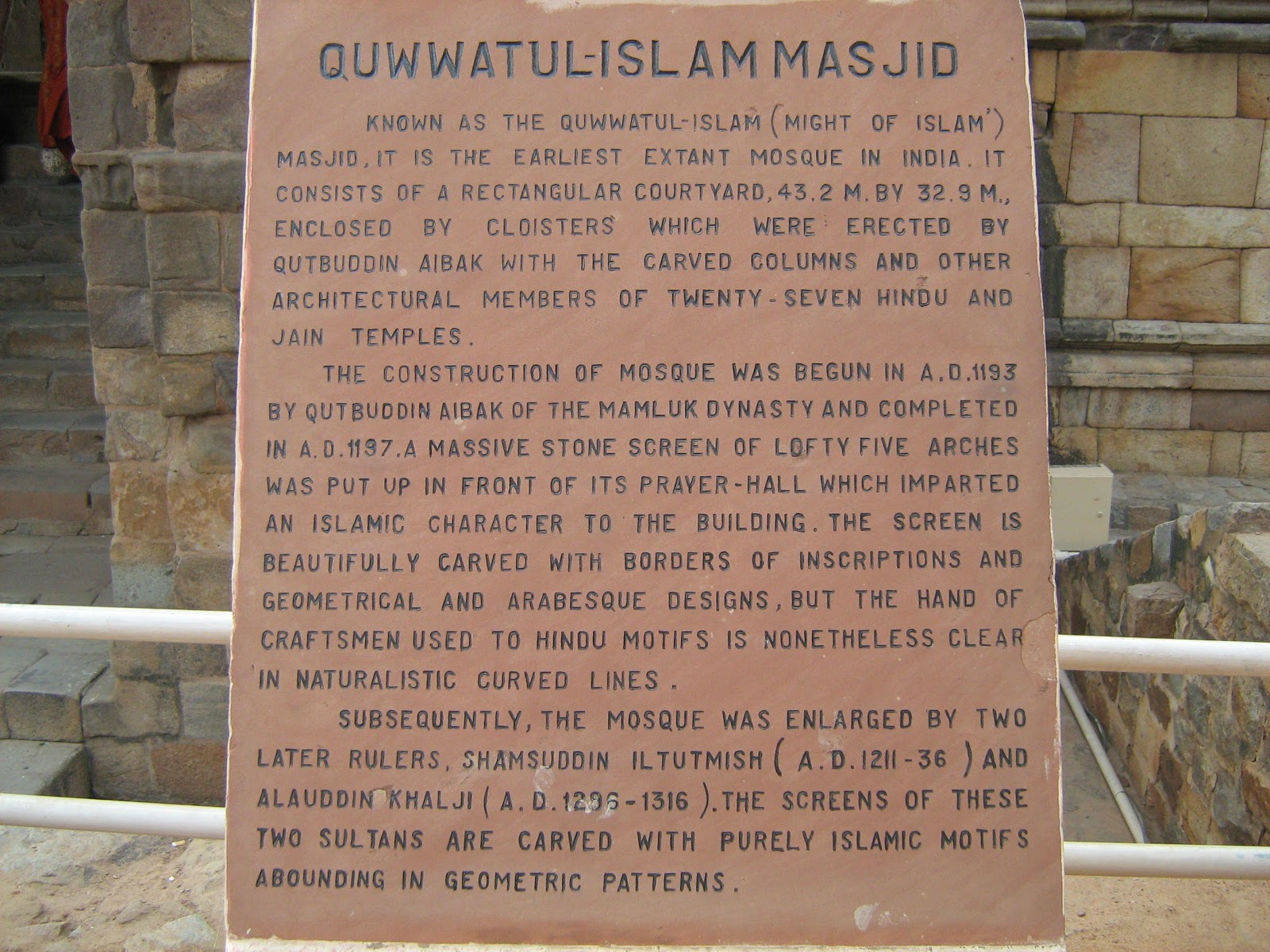
If you happen to visit the Qutab Minar in Delhi, you will discover that the pillars, beams and other members of the surrounding mosque and other structures were removed from some twenty-seven Hindu and Jaina temples after demolishing them. The noses and ears of the figurines of the various gods carved on the pillars were intentionally chipped off to erase their Hinduness. The grand mosque that came up after vandalising so many Hindu/Jaina temples was significantly named Quwwatul-Islam Masjid (Might of Islam), ostensibly to drive home the point. Travel down south to the temples of Belur and Halebeedu and there also you can find signs of vandalism at the hands of the Muslim invaders, albeit of a smaller degree since the invaders did not have much time to make a spectacular job of it.


But what pains the most is to discover how even the holiest places of Hindus were not spared the marauders’ hammers. The intention of course was to establish Islam as the subjugator and the Hind faith as the vanquished. Rama, Krishna and Shiva are among the most revered Hindu Gods, and Ayodhya, Mathura and Kashi are considered their abode. And in each of these places there stands a mosque, at the very places where Hindus go for worship. What if the Kaba at Mecca was destroyed and a Hindu temple came up over its ruins? Would it not hurt the Muslims? Would they allow the temple to remain? To think of it, this will be the exact equivalent of what happened in Ayodhya, Mathura and Kashi, since these places are as holy as Mecca to the Hindus. But will the Muslim Umma accept it? Will they allow you to even discuss such a possibility, if only for debate’s sake? We know the answer, don’t we?


Such things make me very angry. Even Swami Vivekananda was enraged when he saw the extent of vandalism at the Kheer Bhavani temple at Kashmir. “Mother, your devotes of that time could not protect your temple… had I been there at that time, I would never have allowed this to happen,” – such went his thoughts. At that time he heard, as he himself later described, the divine voice of the goddess, “My child, what do you think?–You protect me or I protect you? This temple came up according to my wish and it was destroyed also due to the same reason.”


The above calmed down Swamiji, but we lesser mortals cannot grasp such reasoning easily. But that does not mean I would be wishing Hindus charging to destroy all the mosques that were built on the grounds of Hindu temples. A Hindu is extremely liberal in such things–he can appreciate the fact that such things were common in the medieval times and cannot or need not be undone at our times.


But one thing I earnestly expected of the Muslims at those turbulent times was to understand the hurt that a Hindu felt because of acts of such vandalism, and to let the Hindus know that the Muslims felt much sorry for that. The Vatican regularly does this. But that, sadly, was not to happen. It is not that there did not exist learned, reasonable and accommodative people among the Muslims (the best example perhaps is Maulana Wahiduddin whose knowledge of both Islam and Hindu religion is superior to most of the scholars from both sides) who could have engineered a win-win sort of reconciliation between both the parties. But alas, Maulana Wahiduddin was never heeded to, even discarded as a ‘BJP’s Maulana’ (furthest from being the truth).


Babri Masjid has historically been the rawest wound between the two communities—history is witness to many confrontations over it through the centuries. Here was a historical opportunity to heal the wounds only if the Muslim community decided to show an accommodative attitude—after all this was an unimportant and disused mosque whereas huge Hindu sentiment was associated with it. Such a gesture would have earned the Muslims tremendous goodwill from the Hindus. Why I expect an accommodative approach only from the Muslims is because, firstly, the Hindus were the aggrieved party and not the other way round, and secondly, being a Hindu myself (and here I may be biased), I am sure the Hindus, by their predisposition towards being accommodative, would have reciprocated the well-meaning gesture.


Since this did not happen, the alternatives left were either to maintain the status quo or to set the wrong right through unilateral action (by the Hindus). The first one meant the wound was left to fester, to go deeper, and to create an even greater division between the two communities than that existed. More riots all over the country to follow, more elections to be fought on this issue.


Well, it is the second alternative, of Hindus going on the offensive, is what has actually happened. The plus side of it is that this resulted in a sort of closure, albeit incomplete, in the Hindu mind, which is evident from that fact that even the BJP now acknowledges that the Ram Mandir issue cannot be stirred up into an election issue again. This is good for the country, because otherwise the development agenda of the country would have run the risk of getting derailed time and again. But the most important thing in my mind is the moral side--that a grave wrong was thrust upon the Hindus which they have had a right to redress and have finally done so, albeit in a belligerent manner.


This is of course not a perfect solution. It has left the Muslims to feel now as the aggrieved party. So for them there has been no closure. So there will continue to be more bomb blasts.
In any case, while choosing between two bad options, I think the country has chosen the less bad one.


My whole argument is based on the supposition that the Babri Masjid was built by destroying a revered Hindu temple and thus that act is the ultimate root cause--the original sin. I strongly believe that that there must be a lot of truth in the Hindu belief throughout the centuries that this is Lord Rama’s place of birth. Even if you discard this to be only a myth, there at least existed a ram Janmabhumi temple at that site. Archaeological evidence also point towards that, but given the so-called secular discourse of the country, such evidences are ignored in the domains of government and high-brow media (like NDTV).


Perhaps P V Narasimha Rao, the then Congress Prime Minister, also thought in this manner--that this was a thorn, and to allow the thorn to be removed was the best option that presented itself. So on that fateful day, he chose inaction. But more on him on another day.

Thursday, December 2, 2010

Our Lobbying Journalists

Some time back, before his death, industrialist, media baron and AICC member K K Birla published his memoirs. He described an incident where Sonia G was peeved at the appearance of some unfriendly articles in the Hindustan Times. In order to quell her anger K K had to dispatch Vir Sanghvi, his Editor, to her place to explain to her why as an independent newspaper HT cannot but publish articles of all views, including even those uncharitable to the Congress party or the Gandhi family.
This was, and is, our Vir Sanghvi. I suppose he did not find any violation of journalistic ethics in having to meet and explain editorial principles to the head of a political party. I wonder if he would have done the same with equal ease in respect of, say, the BJP.

V S is a shrewd man. A very shrewd one. When it comes to Sonia G, he uses the proverbial oil, but very subtly. He leaves no opportunity to call Narasimha Rao a ‘crook’, in spite of knowing very well that if bribing JMM in order to save his Govt was his wrongdoing then Manmohan Singh is no less guilty of the same crime. V S knows one thing very well -- to please the Madam, calling Rao names is the most effective way. Another reason behind his hatred towards Rao, I suppose, is more personal. Perhaps he wanted some favours which Rao did not grant (we know how these journalists are).

All this makes me more than happy that V S is now in the dock.

Coming to Barkha Dutt, I always felt she is just a mediocre journalist, with no great insights. Pronoy Roy gave her more importance than is her due, and coming from a person like Pronoy Roy, an undeserved greatness has been thrust upon her. Her offering to lobby is not an aberration, it rather manifests her natural traits.

I am not sure if Prabhu Chawla is also an accused; the media has hushed up the matter in such a way that it is difficult for an ordinary person to know the details. In any case, he is a most ordinary journalist. Now, if he is a co-accused, dishonesty will just be an added feather to his cap.

One point journalist Paronjoy Guha Thakurta makes is very pertinent: “What makes journalists easy targets is the delusion of grandeur that many of them suffer from. Proximity to people in positions of power or wealth feeds the ego of certain journalists, and they feel as powerful and influential as the people they are with." This applies to all the three above.

Monday, August 30, 2010

Another Crusade in the Making?

There is an inherent danger on writing on a subject like Islam when you do not know much about its history. But, as somebody whose land and times are directly influenced by Islam, I still must attempt.

As we see Islam today, everywhere it is in conflict with the others – with non-Muslims with whom the Muslims come into contact. An in-depth study of the Islamic history may explain why this happens, but even without doing so, two major reasons can be assumed.

One, an inherent trait of intolerance that is present in all Semitic religions must have found its way into Islam in the times of the Prophet himself. From the very beginning, it has been perceived as a duty of the Muslim to proselytize and bring the others into its fold – even if that necessitated the use of force.

Two, something that happened later, and happened over and again. In the first half of its history, Islam witnessed at least two golden phases, when science and free thinking flourished. But over time, an urge to go back to the ‘roots’ overtook it – urge to go back to its original, pristine form as is perceived to be revealed to the Prophet. Since Muhammad was declared as the last prophet, all later-day evolutions were considered as deviations and corrupt practices and so were to be rejected.

There are also tolerant streams in Islam, spread from Turkey to Indonesia. We see them in the forms of the Sufis, the Pirs and Fakirs. Interestingly, their influence is more in countries in the periphery and away from the centre (the Arab world -- the birth place of Islam). Unfortunately, the voive of the followers of these softer, accommodating versions is muted and they do not determine the future intercourse of Islam with the rest of the world. Also, though the Shias too do not show much inclination towards tolerance and modern democratic practices, they actively do not go into conflict with the rest of the world. But again, they are a minority.

The majority is the Sunnis, and the strident voice we hear all around is that of the fundamentalist. Not only voice, but the clamour of arms. This stream is gaining in strength ieach passing day. There is no place for pluralism or modern democracy in this version of Islam. I am sure this not to be the real path revealed to the Prophet by the All-compassionate and All-merciful Allah – it cannot be. But, unfortunately, that is how things have taken shape over the ages. The voices of compassion and tolerance are throttled. He who thinks differently cannot speak out of fear. Brainwashing is so absolute that the vast majority in the Muslim world believes 9/11 was a conspiracy by the Jews and similarly 26/11 by the Indians. The duty and goal of Muslims have been defined in very clear terms, and that is, to subdue/convert the non-Muslim world outside its folds (and also the minority sects in Islam) into the Islamic faith and to bring the whole world under Islamic rule.

Sounds incredible? Too fantastic? But there are hordes of people, the soldiers of Jihad, who, from their childhood, have been so indoctrinated in such a belief that they totally believe in the possibility, in the inevitability, in the imminence of this happening.

Ironically, the technological advances of the modern times have helped them. These have produced sophisticated weapons that have come in very handy in the hands of these regressive thinker-soldiers.

If we do a bit of crystal-gazing, the future looks very bleak. The Americans, with their myopic views, have treated the war on terror as a war on the US, and are more than happy in the fact that another attack on their own citizen, on their own soil, so far have either not taken place, or been thwarted. In their complacency, or out of fatigue of fighting a clueless war, they are going to desert Afghanistan soon. Taliban is going to come back in Afghanistan and there mentors/brethren to grow stronger in Pakistan, with all the hidden support they enjoy.

The problem with some vocations like prostitution, militancy, etc, is that you cannot come out of them. You are not accustomed to another form of living and even if you are offered another way, you soon reject that and come back to the old way of life. So, the disincentive to do so must be very strong and extremely punitive. That, unfortunately, is not happening in the present world politics.

In case the fundamentalists seize power back in the Af-Pak region, and partly in Iraq, will they sit back peacefully and restrict themselves to activities within their own countries? Hardly so. This will not satisfy their hunger for Jihad. They will start hatching plots of more attacks against the Western/Hindu/Jew/Christian world outside. Their will be more 9/11’s and 26/11’s. This can be said for certain. That will be the second wave of global terrorism.

If by that time, by a stroke of chance, the US gets a leader more courageous, more farsighted, and less oratorical than Obama, we may see a more focused fight against this menace. Even otherwise, fight the world must, for mere survival. Initially the steps will be tottering, the fights small, localized, half-hearted and indecisive. But a time will come when there must be a very decisive fight, to wipe out this evil of fundamentalism.

I can foresee a protracted, world-war like situation, and if I live another thirty years, maybe some of it I’ll see with my own eyes.

Saturday, July 31, 2010

Daktarda -- Part Two (concluded)

Very little was known of Daktarda's past or his background. He would not talk much about them. As it happens in such circumstances, rumours flew thick and fast. One among them that gained much acceptance was that he had been a Naxalite during his college days. The Naxalite movement was just past its prime in Bengal then. It was quite normal for many among the student community of that time to still feel sympathetic towards the ultra left ideology and Daktarda being one such was no great revelation. However much I tried, though, I personally could not associate the soft, kind and accommodating persona of Daktarda with the dogma and anarchy intrinsic to the ultra leftist ideology. In my opinion, he might have voted for the ultras in the college elections or taken part in a couple of their rallies (we all did that), but a wholesome party activist? I doubted.

Another topic of much speculation was his unknown love life. Being a mouth-watering topic, it took but a little time for all to conclude that at some point of time, Daktarda had been ditched in love. There was no way to know, but to me he did not look or behave at all like one who had received a half-sole the other day and was recuperating from it. Rather, the hint of impishness that always accompanied his smile, accentuated by his lustrous crop of mustache, negated such a notion.

* * *

As I was saying, we split and went our different ways. Since that day, the world had taken at least half a dozen spins around the Sun when our family decided that life was becoming too much of a drudgery, the sun was blazing too hot, and that all these pointed that we might well take a vacation (by 'family' I mean me, my younger sister and the parents, Mr Cat excluded). We zeroed on my maternal aunt's place at Kalaikunda, a major Air Force base located in the Midnapore district of West Bengal, where her husband, a Lt-colonel with the army, was posted at that time (it is another matter that the sun blazed even harder there, but when could the sun and such things really deter the determined holidayers?).

Life at an army base moves leisurely, except of course for the men in uniform who must sprint and bark commands and all that. It goes without saying that we the vacationers, for the first few days of our vacation, had completely devoted ourselves in indulging in Mashi's divine cooking, forgetting everything else; the mid-day meals were diligently followed by afternoon siestas and evening trips to the main market of the nearby town of Kharagpur, ostensibly for shopping but actually for flogging up our sluggish and overworked digestion so that we could do justice to the delicacies that were to turn up at the dinner table.

A visit to Kalalikunda usually includes at least one trip to the airfield. That concluded, we ventured a bit further, to nearby places and even to Calcutta on Sundays to meet our relatives there and also to break the monotony.

On one return trip from Calcutta via the suburban train, somebody tapped at my shoulder and exclaimed:

"Oh my my, isn't that Shome?"

I am among those who find it a wee bit difficult to recognise even a close friend if taken out of context, and it was no surprise that I needed a few squints and a supersonic session of brainstorming before I could place him right.

"Arre, daktarda na?", I babbled, leaving the onlookers of the party in a bit of disarray. Naturally they looked askance at both of us.

In a few minutes the introduction part was over, and since Daktarda was also returning by the same train, we had all the time in the world at our disposal to exchange notes. It turned up that Daktarda had since married and was now the medical officer in charge of a primary health centre at Binpur, an obscure place tucked somewhere in the tribal belt of west Midnapore. He extended a warm invitation to all of us to his place, and the same was accepted by all, needless to say, with utmost pleasure.

It was sooner rather than later that we landed up at Daktarda's place, riding an army jonga jeep. "This stretch is full of bandits", warned our worried soldier-driver. "Do they even attack army jeeps?", I sounded incredulous. "Yes, they do... it happens sometimes... they throw logs on the road and then loot the passengers."

Fortunately nothing of that sort happened, and soon our jeep left the jungle tracks behind and entered the limits of Binpur. Being never in a Santhal village before, the sight of beautifully decorated mud walls of the huts and their sloping thatched roofs left us spellbound. The inhabitants were very poor, but amidst all that poverty the thing that stood out was the spotlessly clean tone of the surroundings.

Before long our jeep entered the gates of a large hospital compound surrounded by brick walls on all sides. It was not only large but had the signs of functionality all over it unlike the usual village Primary Health Centres. To greet us, Daktarda and his very sweet wife (to be Boudi to me) waited in the courtyard, with their only son, a little toddler, perched on its mother's lap. We were taken inside their nice little quarter and it was a sweet surprise to us to learn that Boudi was also of east Bengal origin (known as "Bangals") like us, unlike Daktarda who was a proper "Ghoti" (from the western part of Bengal). This ensured at least one good thing -- that good culinary skills could be expected in Daktarda's kitchen.

Daktartda addressed his mother as 'Tui' (equivalent of Hindi 'Tu') but his father as 'Aapni' (Hindi 'Aap'), something uncommon in a Bengali Bhadralok family but common in the interiors of Midnapore. This sounded very sweet to my ears... it showed the closeness to one's mother that naturally exists in human bonding.

As time went by, I came to know the details of the missing years. To cut a long story short, soon after our split, Daktarda joined the state health service and voluntarily opted for this posting others were unwilling to take. After coming here, he started building his health centre from the scratches. Providence too, at this juncture, lent him a hand. The brother of the local CPM leader (a tribal himself and member of the state cabinet of Ministers of that time) had no child. Daktarda treated his wife (mind you, he was no Gynecologist) and they were soon blessed with a son. Pleased, the Minister wanted to reward him. Daktarda asked of him a proper hospital to be built at Binpur, complete with operation facilities... did not ask for a single thing for himself. The Minister was overjoyed; perhaps he saw electoral benefits in that. An instance when a politician's interest converged with the interest of the common men.

We were now standing on the compound of that very hospital, taking a trip around its compound. For some reason my own bosom swelled with pride.

* * *

I have not met him again. A google search might help. But I have not done so yet. My heart remains peaceful in the knowledge that wherever he is, my Daktarda would be spreading joy and health in the truly needy people, among my poor countrymen.

(It is ironical that the same Binpur now lies amidst hotbeds of Maoist activities... hope that the family, if still there, is not caught in the crossfire.)